Tuesday, 14 May 2013

Measuring light.

Together we had a look at the different ways that a DSLR camera measures light levels to get an appropriate exposure.

Here's a link to some of the resources: http://photographylife.com/understanding-metering-modes

A DSLR will measure the light reflected from a scene (as opposed to the light falling on it) and this is known as a direct reading. Many cameras have three basic metering settings:

Evaluative (or matrix)

Centre-weighted

Spot

All of these can be adjusted in camera. My Canon camera uses TTL (through the lens) light metering that is impressively accurate. All the next images are ISO 800, 17mm lens...

Evaluative/pattern metering: 1/60, f4. The camera has evaluated the entire scene (divided into zones) and used a matrix to come up with the best possible exposure. I find this a great all-round metering mode - but it can be confused by extremes of light and dark.


 Partial metering: 1/60, f4. This metering method covers about 9% of the centre of the viewfinder.


 Spot metering: 1/60, f4. This allows very specific metering of a part of a scene - less than 4% of the viewfinder area.


Centre-weighted average metering: 1/50, f3.5. The scene is metered for the centre and then averaged out for the entire scene - a method of measuring light more common in older cameras.


The scene here has presented no problems for the camera - the light is fairly even and easy to measure. But nonetheless the last method has produced a different exposure.

Metering should reflect the image you wish to create.

Evaluative metering: a snowstorm. ISO 100, 20mm, 1/50, f8


 Spot metering: a reading taken from the tree bark on the right - designed to retain texture and detail.
ISO 200, 50mm, 1/60, f1.8.

Another method is to measure the light itself, irrespective of the subject, and this is known as an incident light reading.
This is something I have begun to do more, although it is not always practical. A reading from an 18% grey card (top rectangle above) disregards the sort of local differences that can confuse the camera meter and often gives an excellent starting point for calculating exposure.

Wednesday, 8 May 2013

Scrapbook

As well as all the technical exercises that are happening I need to put some other shots on here too, and it would be good to have a bit of a scrapbook.


And this is one of this week's favourites: a new park in Salford.


Lenses and focal length

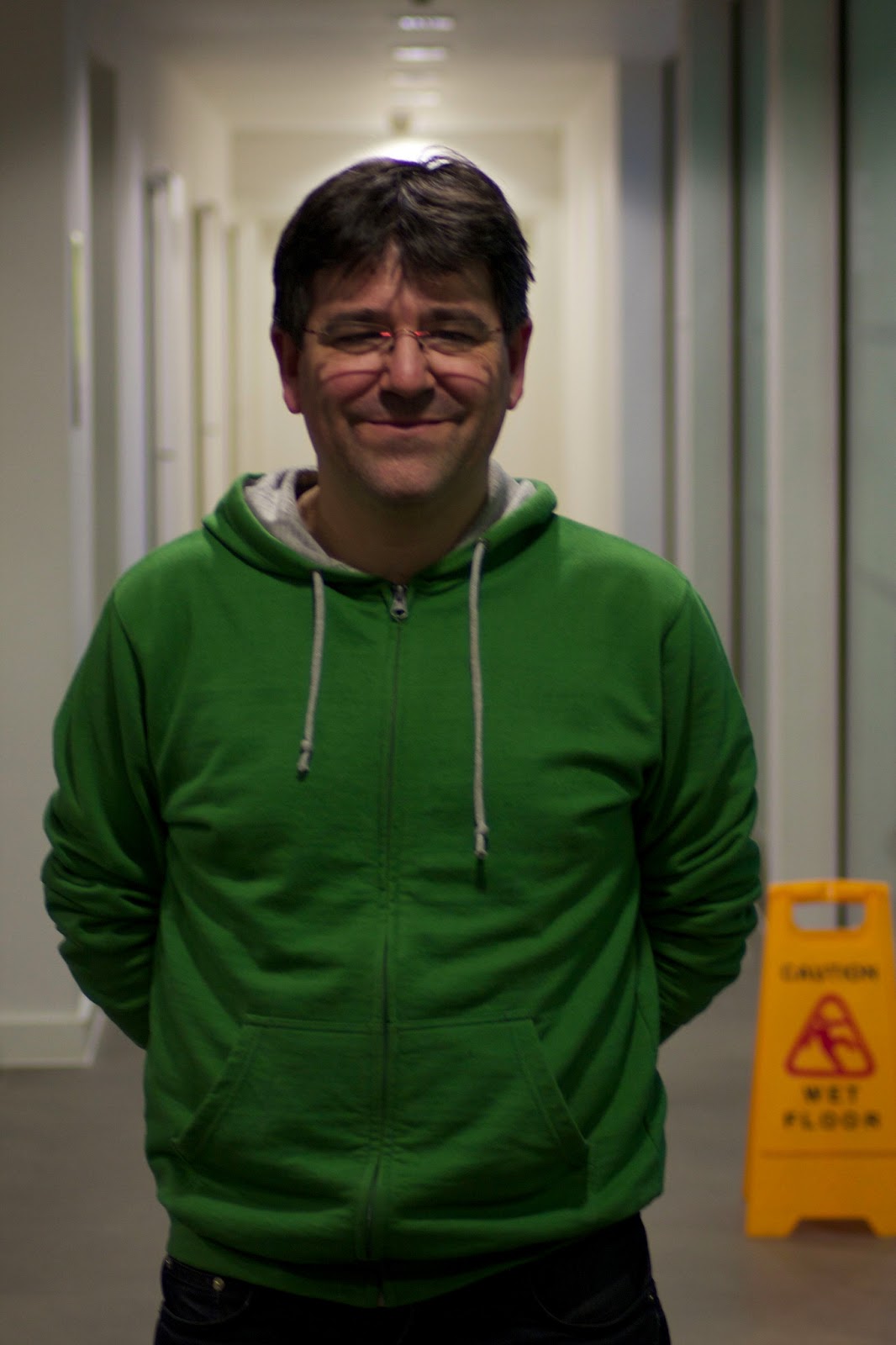
Things have been getting pretty technical around here recently - lots of exercises to get a better understanding of how things (i.e. my kit) work. Here is Fran helping me get a better idea of how lenses and different focal lengths really function.

 1. 1/60, f2.8, 17mm. This is the shortest focal length and so the widest angle on my favourite Canon telephoto zoom. I've shot Fran so that his waist is at the bottom of the shot and there is around a hand's distance above his head.

 2. 1/50, f2.8, 20mm. The idea is to get the same shot - from the waist to a hand above Fran's head - but by working my way through the focal lengths. I take a step back to get this.

 3. 1/60,  f2.8, 28mm. So each time the focal length changes, to keep the same shot I have to move backwards away from Fran.

 4. 1/60, f2.8, 35mm. It is the opposite of what often happens: I can remain in the same spot and as the zoom moves (changing the focal length) it transforms the shot.

 5. As above, 55mm. The longest focal length of my zoom. The difference that the lens and the FL makes to the subject and to the background becomes clear in these shots - Fran at 17mm looks very different to Fran at 55mm, and so does the corridor.

 6. 1/80, f2.8, 50mm. This is a bit of an anomaly - my 50mm lens is EF and so designed for a full-frame sensor/35mm film. It increases the effective focal length on my cameras APS-C size sensor to approx 80mm. There is a link to some notes on this below.

 7. 1/50, f4.0, 70mm. A bigger zoom lens, and perspective is really beginning to get compressed.

 8. 1/80, f4.0, 100mm. The background view that I started with is disappearing fast. I'm a long way away from Fran now, and still moving back for each shot. I am doing the legwork that a zoom lens usually does for you.

 9. 1/50, f4.5, 135mm.

 10. 1/40, f4.5, 180mm. By now I'm at the other end of the corridor. The shutter speeds get slower as the maximum aperture gets higher...

11. 1/30, f5.6, 300mm. ...and this makes camera shake inevitable, particularly hand holding a big telephoto lens. The corridor background has almost completely disappeared and the subject is isolated.

So that is an insight into just what the different focal lengths are doing - not only showing more or less of a scene, but making subtle but distinct differences to the image itself.


 These are my two lenses, not to scale. And below is a telephoto lens (similar FL's to Fran's) that I would very much like to possess!


 A big thank you to Fran for his patience and the use of his lens. Hope to see you soon if you read this! Here's the link to some notes on sensor sizes from one of our sessions:
Sensors and Lenses PDF

Wednesday, 20 March 2013

Light and colour

Over the last week I have been learning a little more about light and colour and how the camera 'sees' these element of the picture.

The white balance is quite technical but it interesting to play with - the settings basically act as filters that can make subtle or dramatic differences to the final photo.

This is Polly


and Polly helped me set up a little still life so that I could have a look at the different WB settings in daylight. This was a bit of an overcast day.


ISO 100, 17mm lens, 1/250 at f3.5 set manually, fill in flash.
AWB  35mm, ISO 100, 1/160, f8.0
 Full sun
 Shade
 Cloudy
 Tungsten light
 Fluorescent
 Flash
 Custom - unset
Kelvin

The camera's estimated setting for this sort of day/light was reasonably accurate.
I tried the same exercise under tungsten light - one that often makes quite a dramatic difference.
 AWB - 35mm, ISO 100, 0.4, f8.0
 Full sun
 Shade
 Cloudy
 Tungsten
 Fluorescent
 Kelvin

I didn't think that any of these presets were accurate for the light or looked particularly attractive, unless you really wanted the yellowy atmosphere. I used a white card from one of the photography magazines to take a custom reading and also used some their 18% grey card to help with the exposure.

The result was pretty striking - a really even exposure and accurate whites and colours.

I want to start to use the white balance more accurately when necessary but also more creatively. These shots of Winter Hill were each with different setting and each has a different feel.

 Tungsten - 17mm, ISO 100, 1/13, f22

 AWB - 20mm, ISO 100, 1/13, f22

Shade - 17mm, ISO 100, 1/10, f22

As the light changes at different times of the day the different WB can be used highten or emphasise colour too. These were taken at dusk using the tungsten setting - something that also helped to create a more interesting atmosphere.

 50mm ef, ISO 400, 1/100, F8.0

50mm ef, 1/80, F8.0